|
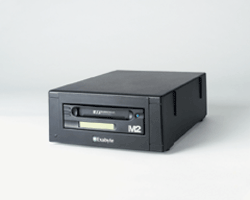
If it were not hard enough to decide between SDLT, LTO and AIT3 as your standard tape format for the next few years, along comes Exabyte with Mammoth-2. Suitable for direct connection to desktops and servers, the Mammoth-2 is available with either Ultra2 SCSI (LVD) and native Fibre Channel interfaces and comes in desktop and internal versions.
We looked at the desktop SCSI version, using an Adaptec 29160 SCSI card to connect the M2 to an HP tc2110 server running Windows 2000 Server.
The desktop model has a plastic case, which is slightly disappointing when you take into account the engineering that goes into the tape drive itself and the cost factor. A metal case would be a little more reassuring especially as this is an external drive.
Mammoth-2 drives use a spinning head that records data in a helical format on the tape as it is pulled across it, just as with a VHS video recorder. Whilst this may deliver benefits in terms of data density and speed, the trade-off is that the drive itself needs to be very well engineered which adds to the complexity and ultimately the cost.
The M2 is designed to provide a native capacity of 60 GB native at a native transfer rate of 12 MB/sec. Exabyte quoted figures for compressed performance are 150 GB and 30 MB/sec respectively. Exabyte supplies its AME with SmartClean tape cartridges in lengths of 75m, 150m and 225m.
Installing the external model is straightforward as all that is required is to connect the SCSI cable and terminator if it is required. The front panel features an LCD display and a bank of LED's to display unit and media status at a glance.
The LCD panel utilises a number of pictograms as well as plain text messages to indicate tape status and health.
The LED's can be used to observe the state of the drive and to monitor tape loading and motion states as well as to check the serial number of the drive, number of hours since the tape head has been cleaned, compression rate, and SCSI or FC status.
Tape loading and ejection is fast but not too noisy and the Mammoth-2 is relatively quiet when in use, a factor to bear in mind if it is to be used in an office environment.
Cleaning duties can be an awful chore but done they must be, so the self cleaning features built into Mammoth-2 drives and SmartClean media will be a boon to many.
To
Read The Reminder of the Article Click Here |